
Accounting. Tax. Financial insight.syed@trueframegroup.com
Home

Quality of Earnings & Transaction Diligence

Understand the earnings
behind the deal.

A Quality of Earnings review examines where reported profits come from, how much is likely to continue, and how those profits translate into cash. We help buyers assess an acquisition and sellers prepare the financial evidence buyers will ask for.

Discuss your transaction

For buyers

Know what you’re buying.

Assess whether the target’s reported earnings can hold up after closing. We test seller adjustments, examine how profit turns into cash, and identify working capital needs and obligations that could affect price or terms.

Start with an initial financial screen or go deeper as records become available. We explain which findings matter to the deal and what evidence you need before moving forward.
For sellers

Be ready to explain your numbers.

Prepare for buyer questions by reconciling historical results, documenting support for earnings adjustments, and identifying reporting gaps before diligence begins.

Start with a sale-readiness assessment before going to market, or commission a sell-side Quality of Earnings analysis to substantiate the financial picture you present to buyers.

Scope of review

Match the depth to the decision.

A summary package can help you decide what to investigate next. Testing individual transactions requires more detailed records.

Initial financial screen

Review the available statements and deal materials, identify the issues that could change the decision, and prioritize what to request next.

Limited-scope QoE

Focus on agreed earnings and cash questions. Test selected adjustments and trends against the available support and explain what remains open.

Detailed financial diligence

Where records are available, reconcile statements and notes to ledger, subledger, and bank evidence. Investigate material exceptions and show how they affect the buyer’s view.

What we test

What could change the deal?

For a material finding, we show the evidence, what it means for the buyer, what remains unresolved, and how to verify it.

Performance & revenue quality

Assess growth, margins, seasonality, and customer or product concentration. Compare with relevant peers where definitions and evidence support a meaningful comparison.

Earnings & reporting integrity

Test seller adjustments, recurring costs, and significant reporting judgments. Separate supported adjustments from items that could change the answer but still need evidence.

Cash, working capital & obligations

Explain how earnings turn into cash. Assess seasonal working capital, capital spending, and debt-like items that could affect cash required at close or the terms of the deal.

An illustrative example

What will it cost to replace the owner?

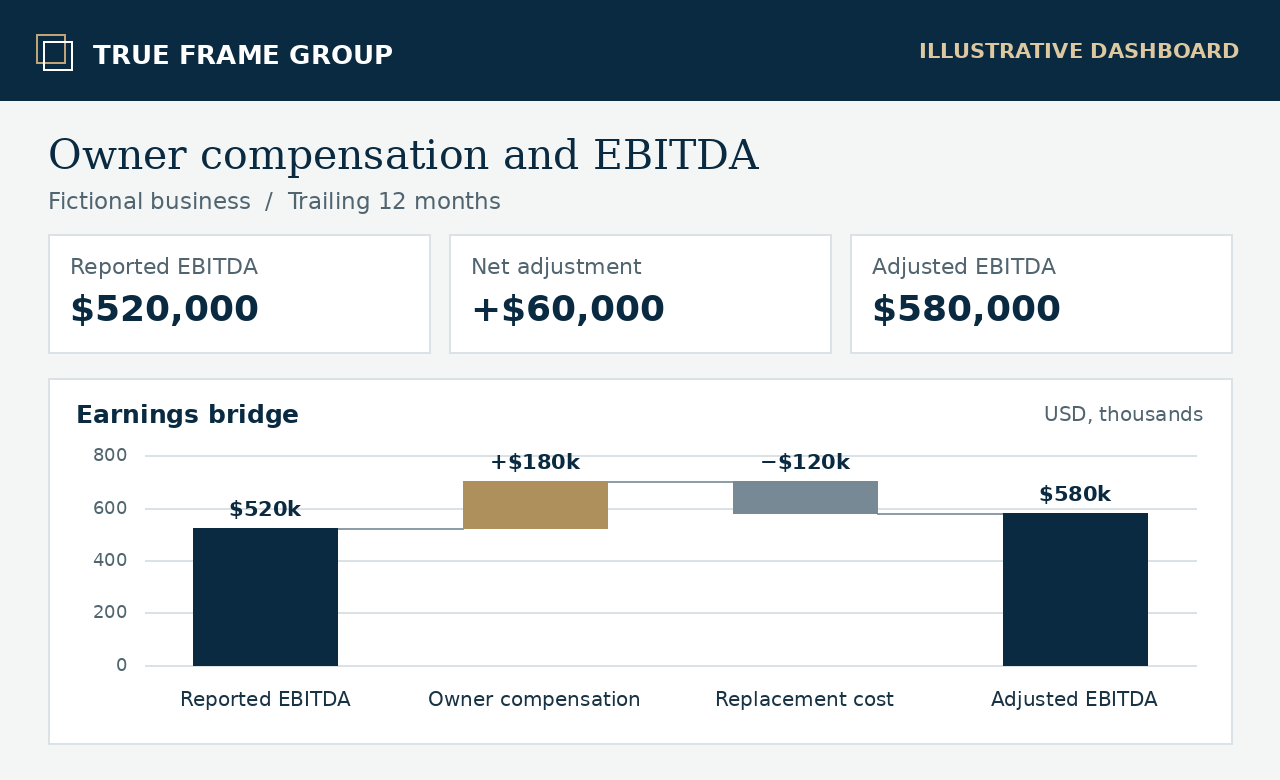
A seller adds back $180,000 in owner compensation. If the buyer needs to hire a manager at a fully loaded cost of $120,000, the supported adjustment would be $60,000 once both amounts are substantiated.

The buyer can evaluate the deal using a realistic cost base. The seller can document the duties that transfer and the evidence for the replacement cost.

See the buyer-side earnings bridge
Illustrative earnings bridge showing reported EBITDA of $520,000, plus $180,000 in owner compensation, less $120,000 in replacement cost, yielding $580,000 in adjusted EBITDA.
Sample dashboard with fictional data.

Optional scope

Valuation & acquisition underwriting

When the scope and evidence support it, we model what the business may be worth, how a purchase could be financed, and how the buyer’s returns change under different assumptions.

Value of the business

Estimate a supportable range using discounted cash flow, relevant closed transactions, or an asset-based analysis where appropriate. Explain the strength and limits of each method.

Financing & downside

Model funding needs, debt service, and cash reserves under base and downside scenarios. Assess whether the business can carry the proposed financing.

Buyer returns & offer analysis

Show how price, deal structure, and financing affect buyer returns and payback. Distinguish the value supported by the business from the maximum price a particular buyer can justify under stated assumptions.

Deliverables

What you receive

A clear view of the earnings and cash flow the financial records support, the issues that could affect the deal, and the questions that still need answers.

Written report

An executive conclusion and plain-English analysis you can review with your team or advisers.

Private interactive dashboard

Explore financial trends, earnings adjustments, and key findings in one place. The dashboard can serve as the primary deliverable.

Supporting Excel model

Trace calculations, review adjustments, and explore scenarios in an editable workbook.

We agree on the right format or combination when we scope your engagement.

Let’s frame what comes next

Tell us where you are in the deal.

Share whether you’re buying or selling, your timeline, and the financial questions you need to answer.

Discuss your transaction